
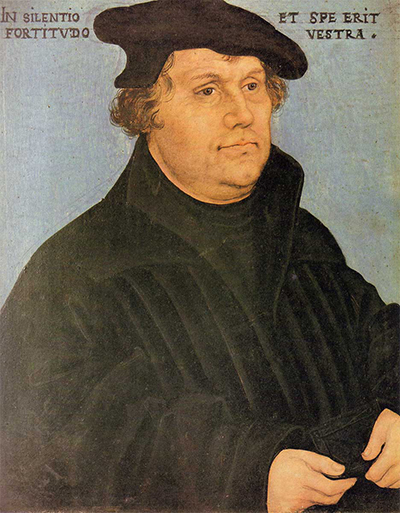
Protestantism came to prominence in Europe in the 16th century and spread unevenly across the continent. This new Christian denomination aimed to thoroughly reform the Catholic Church. What seemed to bother it mostly was the ease with which people could have their sins forgiven by merely buying an indulgence issued by the Vatican. Martin Luther (1483-1546), a theologian and Professor at Wittenberg (Germany) is considered the ‘father’ of the Reformation.
Reform greatly encouraged literacy in Western Europe by spreading Luther’s strong conviction that “everyone should be able to read the Bible”.
The rise of the Reformation gave wars in Europe a new reason as they became increasingly motivated by religious matters. John Sigismund II endorsed the Edict of Turda, (Torda in Hungarian; 1568), meant to calm down spirits in Transylvania. The edict stated that “no one could humiliate anyone else on the ground of their religious beliefs” and enabled preachers to freely speak of their beliefs in public, without fear of punishment.
John Sigismund II encouraged the spread of the Reformation in Transylvania. Whether it was out of personal conviction or as a means to defy the strongly Catholic Habsburg Emperor it is difficult to say.
In 1567,John Sigismund II launched a campaign to promote the Reformation among Romanians in Transylvania and appointed George of Sângeorz superintendent of the Romanian churches. Orthodox priests were also compelled to celebrate mass and all other divine services in the language of the Wallachian population.
In the “Reformation Book” (1543), Johannes Honterus (1498-1549), a humanist scholar from Brașov, reports that schools established everywhere with community money had fallen into a pitiful state and that Reformed believers stepped in to make sure young people with a leaning toward learning had where to study. The booklet also mentions a systematic programme run by Reformed communities to establish schools in all Transylvanian towns. Honterus suggested that Catholic monastery properties be secularized to provide money to support the poor as they were no longer of any good.